Showing posts with label rock oasis. Show all posts

Rock Oasis Setback: New Gym on Morse St. Cancelled

This sucks.

The Rock Oasis Morse St. Gym Project is Dead 

A little over a year ago, my home climbing gym, The Rock Oasis, was forced to move from its historic location at Front and Bathurst to make way for a condominium development.

Since then, the gym has been operating at an interim ‘transitional’ location on Carlaw Avenue. Meanwhile, exciting plans were drafted to construct a lofty bespoke facility, on nearby Morse Street.

Alas, those optimistic plans have been derailed (see notice above).

I’m disappointed.

The remaining Oasis regulars have largely accepted the major weakness of the Carlaw location -- a dearth of height -- by rationalizing (perhaps fantasizing?) that soon enough, a delightful new gym (with 60 foot routes) would be built for us to play in. All we had to do was be patient.

Now -- I’m not sure what to think. Will another suitable spot be found in which to roost? Or are we stuck at Carlaw for the foreseeable future?

What’s your favourite gym?
I’m often asked what my favourite climbing gym is. My reply is that each spot has a different flavour, a different feel. The main factors to consider are location, route-setting, physical setup and facilities -- and the people who climb and work there. How to weight those factors is a unique equation for everyone. There isn’t a single definitive answer.

Settling in for a longer than anticipated stay...
Knowing that the Morse project is dead, I have to ask myself, is the Carlaw Rock Oasis the right choice for me long-term?

That sounds kind of harsh. Switching climbing gyms is not something I’m prepared to entertain lightly.

Have I been having fun at Carlaw? Sure. It’s grown on me. I like the spaciousness. The routes are thoughtful and challenging. I’ve come to know the surrounding neighbourhood, and I’ve still got lots of friends who frequent the place.

Heck, I even met a girl there. :)

But it hasn’t been the same, climbing-wise. So many times I’ve done a route and thought, that would be an amazing climb if another twenty or thirty feet were tacked on top.

I have a lot of respect for Karen McGilvray (the proprietor) -- not many people can say they’ve built three climbing gyms -- and Cort McElroy (the General Manager), so it’s really tough that things didn’t work out for the Morse scheme.

Guess I’ll have to sleep on it. Not to mention get working on that new orange 12a roof...

See Also
Between a Rock and a Great Place (pdf)
National Post article discussing some of the challenges faced by Ms. McGilvray in setting up the transitional gym on Carlaw.

The Bathurst Rock Oasis: A Look Back
Nostalgic photos of the Bathurst gym interior.

The Wreck of Rock Oasis: In Pictures
Photos from the demolition of the old Rock Oasis.

Farewell to Rock Oasis
A detailed historical examination of the industrial structure in which the Rock Oasis was originally located, as well as the surrounding neighbourhood of Front and Bathurst. The essay also includes an interesting (if I may be permitted to say so) interview with Ms. McGilvray on the history of the gym itself.


The Bathurst Rock Oasis -- A Look Back

It’s been a year since The Rock Oasis closed its doors on Bathurst, and moved out to the east side. What happened was, a condo developer bought the site, kicked out the climbing gym, and tore it all down -- the classic fate for historical buildings in Toronto.

I really miss the old place. I want to share some photographs with you, for nostalgia’s sake.

I’m bitter that the developer was in such a hurry to demolish the structure. What was the result? A few mildly interesting designs -- and a vacant lot.

Then: June 27, 2011 - the Last Night
June 2012 - An empty lot (note the Minto temporary structure in back)

They could have just as easily let the building remain standing ’til now, and gotten the same result. Losing the site to condos was inevitable -- but ousting the gym a year early, for no practical purpose, was galling. [Construction in... 2013? Give me a break]

I guess I’m a crank.

The whole affair took me awhile to process.

The ‘transitional Oasis’ on Carlaw has been ok. It’s too short, but I still go. I got used to it. I have many friends there, and it’s the most geographically convenient climbing gym for me. The route-setting is solid given the constraints, and I’m looking forward to the new spot on Morse Street -- if ever and whenever it gets built.

But my heart pines for the old shed. It was home.

The Rock Oasis on Bathurst -- In Photos
Before the end came, I tried to take some interior shots for posterity. I’m not good with picture-taking and composition, so my goal wasn’t about revealing the aesthetics of the place, as much as documenting the literal perspectives I had experienced as a climber there.

As a result, the photos are mundane, repetitive, and there are more of them than are reasonable. But it’s all I have left. If anything, I feel like I missed numerous vantage points.

Click the images below to browse the photos (arranged in two somewhat arbitrary sets).

Set 1: Bathurst Rock Oasis Interior
Set two:
Set 2: Bathurst Rock Oasis Interior 2
Note: a small # of these are from a friend, G.

The images bring back a host of vivid memories. I find it striking to see just how compact the place really was. And I had forgotten how many different surfaces and angles and nooks and crannies there were to the walls. We had a lot of good times there.

We miss you, Bathurst Oasis!

Also of Possible Interest
(click images below to view associated post)

Photos from the Demolition: The Wreck of Rock Oasis -- In Pictures
A pictorial coda, taken the night before it all came down for good...


Farewell to Rock Oasis: my lengthy essay on the history of the building
at Front and Bathurst, and of the surrounding neighbourhood

Covered in the Globe and Mail, mentioned online by Gripped, and overall positively received, my rambling essay deals with the forgotten history of the building (also known as the Doty Engine Works), and the surrounding neighbourhood at Front and Bathurst -- as well as the history of the climbing gym itself.

Check it out if you haven’t read it! There are tons of great old photos of the building in the piece.


A Light Catch
See also
Rock Oasis Setback -- New Gym on Morse St. Cancelled
Condo Developer Borg
What’s to come at Front and Bathurst
No, I’m not involved with StopMintoFreed

Secret bonus video tour -- your reward for reading to the end. Thanks.

Reminisce with me in the comments!


The Wreck of Rock Oasis -- In Pictures

Disclaimer: Unsupervised, unauthorized exploration of structures undergoing demolition is not recommended. Such activity may be dangerous or illegal. You are responsible for your own actions and safety.

Earlier this year, a condo developer demolished the gritty industrial structure that housed my old climbing gym, The Rock Oasis. It only took about a week to raze 120 years of rich history into the ground.

Sic transit gloria mundi!

Standing tall for one last night...

The destruction of Oasis was personally heartbreaking. I loved climbing there -- in spite of its flaws. Although these photos were taken months ago, it’s taken me a long time to publish this post. The hesitation stems from emotional inertia.

Intellectually, we all knew what was going to happen. But actually seeing the physical Victorian-era bricks and beams strewn and twisted about -- that has been tough to stomach.

These assembled photos (from several sources) are part of my process of moving forward. They’re ugly, and awful, and make me feel sick, but they are also an acknowledgement of reality.

They are a record of what used to be at the corner of Front and Bathurst, and of the violence required to tear it down. If you loved the gym, you’ll hate these pictures. Sorry.

(And yes, I’m still angry that the developer chose to dismantle the place so early, when they didn’t have to. It will be at least another 6 months, easily, before anything even happens with the site.)

I’ve arranged the photos into three different parts, and added credit/commentary where desired. Certain shots are thematically repetitive -- that’s just the way it goes.

Click below to view each set (opens in a new window).

Part 1: Demolition (click photo to open) - set of 20
Part 2: Last Night On Earth (26 photos)
Part 3: Aftermath (30 photos)

Stay tuned -- I have one final post left in this series. It will be a different photo collection -- a nostalgic look at all the nooks and crannies of our old place. I’ll get to it eventually, I’d say in a month or two... Update: See The Bathurst Rock Oasis - A Look Back

Comments are always welcome!

Note: Rock Oasis still operates; they moved to a transitional gym in the city’s east end.

Context and intention
This post is a pictorial coda to my essay: Farewell to Rock Oasis.

Covered in the Globe and Mail, mentioned online by Gripped, and overall positively received, the essay deals with the forgotten history of the building (also known as the Doty Engine Works), and the surrounding neighbourhood at Front and Bathurst -- as well as the history of the climbing gym itself.

Check it out if you haven’t read it! 

Notes, Disclaimers, Sources & Acknowledgements

Farewell to Rock Oasis took significant research to assemble. As with any endeavour of this nature, some prudent meta-commentary is always useful.


Notes and Disclaimer 
When I refer to 'the Rock Oasis' I am speaking about the Bathurst-era Rock Oasis, not the transitional gym on Carlaw.  I also use the present tense, even though the Bathurst gym will shortly no longer exist and the usage will seem incorrect in due time.

What I've presented here is my version of events. It is by no means authoritative.

Errors in my interpretation of the facts may have easily crept in during the compilation of this work. I gratefully appreciate the submission of any amendments or relevant additions to areas where I have been a little fuzzy -- or wrong -- in the comments. At times, different sources provided contradictory dates or information.

Even after all this research, I am still not absolutely certain of the exact year the Oasis structure was built! It looks like 1890, based on the Goads insurance maps and the Property Assessment rolls. But it might be a year or two earlier. Nor is it 100% clear whether the south tower was built as part of the original construction by John Doty, or later by the Bertrams -- or even the Berg family.

Construction in that era, particularly relating to the industrial waterfront, was often unregulated. Permits for some buildings exist, and not for others.

Because the web offers a fairly unlimited medium of communication, I have not edited the entries for brevity. In some cases, I have pursued the details to a degree that may not be of interest to everyone.

Lastly, it will be obvious that this history is maddeningly incomplete. I ran out of time -- as has the climbing gym at Front and Bathurst -- and I chose to focus my research on the Victorian and early 20th century time periods, which interest me the most. I am planning to investigate if there is additional information at the Fort York archives regarding the Rescue Inn; if I discover new data that I feel is interesting, I promise to update the appropriate sections.


Acknowledgments and Sources
Obviously, thanks go to Karen McGilvray -- for having the entrepreneurial tenacity to build and run a great rock climbing gym, in the face of countless obstacles. There will be other gyms that come and go in the GTA, but Oasis is the one she built, and I thank her for that. Her time and prior research regarding '27 Bathurst' were invaluable for this essay.

Thanks to the staff at Rock Oasis. You have always made the gym a friendly and welcoming place to climb. Cort, Sam, Jamie, Josh, Erika, Rami, Daniel, Grace, Max, Geoff, Adrian, Jean, Susan, Adrian, and the rest of you -- you guys are awesome.

Thanks to my many, many fantastic friends in the climbing community. I know you all share in this loss -- even if you don't climb at Oasis. When a climbing gym shuts down, it sucks for everyone. Thank you for your support and for the encouragement.


Primary Sources
If I've overlooked any obvious sources, excoriate me in the comments and I'll rectify the situation if warranted.


Photo Credits
Most of the historic street and map photos come from the City of Toronto Archives, who were gracious enough to put up with my bumbling presence and endless questions. Technically speaking, I was supposed to fill out an Image Reproduction Request form for every single photo from them, which I did for a good chunk of them, but I'm pretty sure I missed a few. Additionally, each photo is supposed to have a citation adjacent to or in close proximity to the image to which it refers, e.g. City of Toronto Archives, Series 372, Sub-Series 5, Item 74. "A reference to the 'City of Toronto Archives' in the final credits or acknowledgements is insufficient."

Err... How about my paying $28.25 for the digital image of Series 372, Sub-Series 5, Item 74, and we'll call it even?

The modern photos were taken by me except where otherwise noted.

If anyone needs to know the provenance of any photo in this essay, contact me and I can instruct you on how to find it... Fair use, fair dealing, academic provisions, expired copyright, public domain, etc. etc. Welcome to the digital age! Arrrrr....


Corrections welcome
Alas, I am no methodical, trained historian. Any omissions, errors of fact or deficiencies of scholarship regarding the gym, its history, or Toronto history, are mine entirely. Any opinions expressed are mine, or are an interpretation of opinions expressed based on my notes.

Please submit any corrections in the comments, or to me directly. I would also gladly welcome additional information about or more old photos of the Oasis building from the past. I looked as hard as I could, but the Archives stymied me.


Read the next section:
That's it! There isn't any more to this essay. Check out the rest of my blog, recursion!

Update (Nov 24, 2011): I’ve added an epilogue: The Wreck of Rock Oasis -- In Pictures

You've been reading: Farewell to Rock Oasis, the secret history of my home climbing gym. Thanks for reading!  

Table of Contents
Like, Share, or Comment on this post!

A History of Front & Bathurst - Victorian/Early 20th Century Era

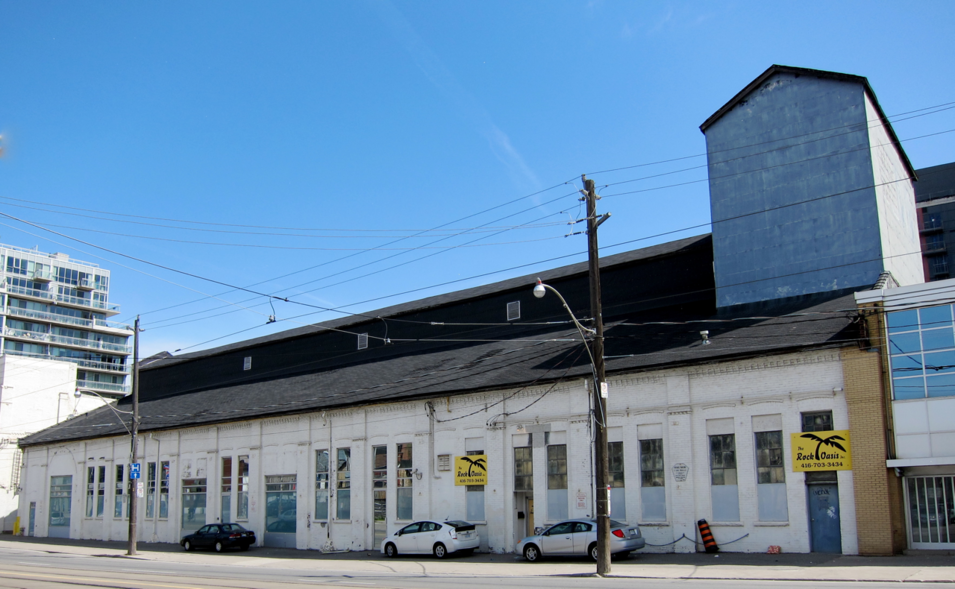
The Rock Oasis is housed in a hulking industrial building on the north-east corner of Front and Bathurst, Toronto. The structure is over one hundred years old, and, as we shall see, the site of the building has been associated with some of the most prominent figures and stories of Toronto's industrial past.

Rock Oasis at Front and Bathurst

The surrounding neighbourhoods, known as the Wellington Place Neighbourhood, and the Niagara Neighbourhood, are vibrant with heritage legacy. Nearby Fort York and Victoria Memorial Park combine to form a National Historic Site that effectively straddles the lot on which the building sits.

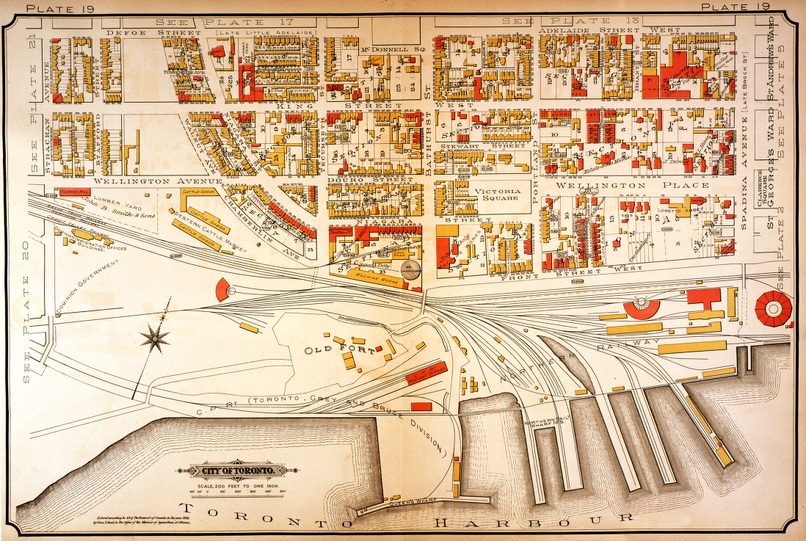
1894 Goads Fire Insurance Map

The story of Front and Bathurst is surprisingly convoluted. It is filled with tangential details, intermingled relationships, and 'n degrees of separation' linkages. The site has been a bystander and occasional participant in the very development and evolution of our city.

In the following posts, I examine several notable historical events, characters, and uses that the site and neighbourhood have witnessed. In the process, I hope to provide a certain historical context, to bring these stories to life, and to foster an appreciation for what we're about to destroy.

Aerial view of Front and Bathurst


Read the next section:

You're reading: Farewell to Rock Oasis, the secret history of my home climbing gym.    

Table of Contents

Like, Share, or Comment on this post!

John Doty’s Engine Works: 1881-1895

“Small Beginnings often make Great Endings”
John Doty was the man who built the industrial structure we know today as the Rock Oasis.

Doty was an energetic, ambitious, and thrifty machinist with many interests, whose formidable business acumen guided him to success in Toronto. He ultimately controlled several overlapping enterprises involving: engine and machine works, shipbuilding, ferry operations, and amusements on Toronto Island.

From Prominent Men of Canada, G. Mercer Adam

Born on a farm in the township of Lewiston, Niagara county, New York in 1822, John Doty had a lineage that traced back to Edward Doty, one of the original Mayflower pilgrims of 1620. He was the second youngest child out of seven. He learned the machinist trade from Mr. Lewis Kenyen in Rochester NY at the age of 16, and four years later moved to Niagara Falls.

Stints in Toronto, Oakville, and Hamilton followed, and at each step Doty took a larger role in business affairs, eventually selling his firm in Hamilton in 1872. In 1875 he moved back to Toronto. He started a machinery shop at the foot of Yonge street, on the west side of the slip, but eventually outgrew those premises.

He then purchased property at the foot of Bathurst, on the west side -- from the Masseys, in 1883.

This 1876 view of the north-west corner of Front and Bathurst shows the Dickey, Neill and Co. Soho Foundry, later occupied by John Doty. JH Dunn’s house is shown at the top right. From Bird’s Eye View of Toronto, 1876 P.A. Gross.

This western lot was previously occupied by the Dickey, Neill and Company Soho Foundry, which operated from 1875 to 1877, after which the premises were taken over by the Toronto Reaper and Mower Co. This company was then acquired by its rival, Massey Manufacturing Co. in 1881 (Massey would later become Massey Harris, Canada’s largest manufacturer of agricultural implements and Toronto's leading employer, at a famous complex of factories further west on King).

The view from the original west-side machine works: Doty eventually moved across the street to expand  

Doty commenced operations therein for a large machine works (presumably it was around this time that he lived in the John Dunn house). This machine works was also previously depicted in the 1884 Goads Insurance map. Structural remains of this building can still be seen physically, in the lot at the foot of Tecumseth on the south margin of the property.

1890 Goads Insurance Map showing
Doty's Machine Works - on both sides of Bathurst


The Doty Engine Works
Once more, Doty’s business outgrew the premises, and with the intent of moving, he purchased new property on the east side of Bathurst, just above Front street, shifting operations sometime around 1889.

1893 Chromolithograph excerpt, Barclay Clark & Co.

Take a look at this massive -- not to mention gorgeous -- 1893 Chromolithograph of Toronto by Barclay, Clark & Co. Expand it to its full size, and you'll see that the familiar warehouse shape of Oasis appears to have already been built! But where is the tower? And where is the Rescue Inn?

Doty’s machine works on the west side of Bathurst are also visible.

Unfortunately, it was common practice in drawings like this to include structures not yet constructed, as well as prospective buildings. (Observe City Hall (then new, now old)'s presence -- yet old City Hall was built in 1899.) So the date isn't quite as reliable as you might think.

The 1891 Assessment Roll showing Doty and sons' presence
on the east side of Bathurst. Of note: Doty is 68! 

The ‘1 story’ entry in the above Assessment Roll indicates the total Works structure -- the length (200 feet) and value support this interpretation. Does the ‘3 story’ entry represent the tower, or is it the Sherwin Williams building to the north?

There is no listing for Doty on the east side in the 1890 Assessment; this fact, taken together with the 1890 Goads map and a similarly new entry in the 1891 Might’s city directory, suggests that the east side Bathurst Doty Engine Works were constructed in late 1890.

An archeological clue as to the building's construction date. It turns out that Oasis’ peeling white paint covered another amazing link to Toronto’s industrial past! Soft-mud molded clay ‘John Price’ bricks were manufactured at the Don Valley Brick Works, starting in 1889 -- implying that this portion of the structure was built no earlier than that year. These bricks were the Brick Works’ most prominent brand -- the majority of Toronto houses south of Eglinton are built from similar bricks. This photo taken onsite during the demolition of the Doty Works - July 22, 2011. Most of the bricks in the rubble were unbranded, but I chanced across this one and dredged it out for a closer look.  
1891 Might’s Directory -
Doty’s first listing on the
East side of Bathurst

Doty prospered in his new spot on the east corner of Front and Bathurst, where the Rock Oasis climbing gym would eventually be built. The location proved to be the launching pad for Doty's sizeable business empire.  Doty built all kinds of machinery, and for any purpose.

Here’s a multi-page advertisement for one of Doty's products, built and sold at Front and Bathurst:

The Doty-Vertical Steam Engine and Boiler

(Advance the pages to see the full description, more prices, and other products sold by Doty!)
"A man with a technical knowledge and who is a good mechanic is a better man than a mechanic without a technical knowledge… Men who have not a technical knowledge are only equal to inferior men."
- John Doty

In January 1888, Doty was called before the Royal Commission on the Relations of Capital and Labor in Canada.

There, he was asked to testify on the importance of technical education. Doty's testimony provides a riveting glimpse into the working conditions that prevailed at his Machine Works over one hundred years ago.

The interview, reproduced below, is highly recommended reading (it's only a couple of pages long, and it starts near the bottom of page 326). At this point in time, Doty managed over 100 employees at the Works, ranging from unskilled labourers to highly adept machinists.


If you ever wondered whether the staff at Oasis were underpaid, imagine working fifty-seven hours per week, ten hours a day during the week, and working till 4 on Saturdays… making $2.25 a day as a senior machinist!

Doty's Machine and Engine Works, and the expansion of the railroads south of Front Street, changed the character of the Wellington and Niagara neighbourhoods. Industry became the accepted norm in the area; this was symptomatic of how Victorian Toronto divided itself into more clearly defined residential, commercial, and industrial districts. A side track from the Grand Trunk Railway ran directly to Doty's premises, enabling the company to receive material from any part of the continent, and to load and ship machinery to all parts of the country.

The building permit for Doty’s foundry. This was the closest I came to finding the permit for the Engine Works, which were constructed a couple of years earlier.

The Doty Shipyards
Yet engines and machinery were merely the foundation for the striving industrialist. The John Doty Company (John Doty and Sons) was the first ship building company organized in the Bathurst Wharf area. Formally declared in 1891, the company built a shipyard at the foot of Bathurst near the bay, occupying the Northern Railway wharf south of Portland [see the full 1890 Goads]. Between 1890 to 1893, Doty constructed these six vessels, keeping his machinists frenetically occupied:

- Mayflower
- Primrose
- Mistassini
- Garden City
- Petrel
- Medora

A sketch of the Mayflower. Note the octagonal 'birdcage' pilot houses

The Primrose and the Mayflower were identical sister ships designed by W.E. Redway, both launched at the Doty shipbuilding yard and used as Toronto Harbour ferries. At the time they were the largest-capacity ferries in the Harbour. The boilers and other parts for these ships were constructed, naturally, at the Engine Works. Both vessels lasted until 1938, when they were scrapped and rebuilt as work barges. Robertson's description:
"The Mayflower and Primrose, are sister ships, and are not only justly prized by their owners, but greatly appreciated by the general public. Their appointments are as nearly as it is possible for them to be perfection and every reasonable convenience is afforded their patrons. Their framework is of steel, their length just exceeds 140 feet and their breadth 28 feet. They are two-decked, double-bowed paddle steamers, and were built in Toronto in 1890 by the Doty Engine Company. They each possess two diagonal direct acting 29 horse power condensing engines by the same company as built the steamers [Doty]. Their tonnage is 189.40, and they are permitted to carry 900 excursionists."
- Robertson’s Landmarks, Volume 2 
"Both these steamers are lighted throughout by electricity, and when loaded with pleasure-seekers at night present a gay and unique appearance. They are universally considered the finest ferry steamers to be found between Hudson's Bay and the Gulf of Mexico. One pleasing thing in connection with them is that almost daily throughout the season hundreds of the inmates of the charitable institutions of the city are provided with free excursions upon them by their proprietors."
- Toronto Telegram 

From Mike Filey's Trillium and Toronto Island: The Centennial Edition

Postcard of The Garden City
The Garden City was a 180 foot ferry built in 1892 by Doty's company to ply a ferry trade between Toronto and St. Catherines.

The Luella (the angle in this photo makes the vessel appear stubby). Note the canvas curtains, usually dropped in inclement weather. The octagonal pilothouse was eventually removed in a 1908 refit. 
The Luella, an earlier vessel built by W. Armour in conjunction with Doty, was built in 1880, boasted a 24hp high pressure non-condensing engine from the Doty Engine Co., and was widely known as the "handsomest, fastest little steamer on Toronto bay". With a tonnage of 38 tons and a capacity of 122 passengers, it sported the record for most lives saved from drowning, and City Council awarded her captain a set of colours in recognition.


The Doty Ferry Service & Island Amusements
Doty's ferry construction went hand in hand with another focus of his -- ferry operations and Island amusements. In the late 19th century, two ferry companies were predominant: A.J. Tymon's Island Ferry Company and the Turner Ferry Company.

Doty purchased the Turner assets in 1887 for $14,600 (John Turner had passed away) to form the John Doty Engine and Ferry Company. Doty controlled the wharves at Yonge and York, as well as the wharf at Hanlan's point. With his sons, Doty ran and operated the Toronto Harbour ferries for about five years.

From The Globe, July 17, 1886

Imagine -- a patron of this theatrical showing of HMS Pinafore would sit in a theatre built by Doty, having taken the ferry service operated by Doty to arrive there, using a ferry built by Doty, with a thrumming Doty engine at its heart! An audacious example of Victorian vertical business integration, to be sure.

Doty Ferry Lines at Hanlan Hotel on the Toronto Island, sometime between 1885-1895
Note the Doty Island Ferry docks on the left side of the Hanlan Hotel. The Hotel was run by the famous rower Ned Hanlan, and its bar had a reputation for being a gathering place on Sundays where 'boys' would come to drink. Also observe the ad for 'Doty's Coney Island Carousel' on the right.

Lawrence "Lol" Solman, general manager for the Toronto Ferry Company.
From Trillium and Toronto Island, Mike Filey

In 1890, Doty's company was merged with the Tymon operation to form the Toronto Ferry Company, a joint stock company capitalized at $250,000. The Toronto Ferry company under general manager Lawrence Solman is notable for constructing (presumably with Doty's knowledge as a shareholder in both the TFC and the Island Amusements Company) an amusement park in 1894 at Hanlan's Point, as well as the adjacent Hanlan's Point Stadium in 1897 for the Toronto Maple Leafs baseball club. [Babe Ruth would hit his first professional home run into Lake Ontario from a later incarnation of this stadium]

People waiting for the ferry at the Doty Company Ferry Docks at Hanlan's Point. Note the pavilion for 'Doty's Hippodrome' on the right -- Doty was a shareholder in the Island Amusements Company.
City of Toronto Archives f1478_it0035 (FW Micklethwaite.)

The ferry license of the Toronto Ferry Company would go on to be acquired by the Toronto Transportation Commission (1927-1954), which morphed into the Toronto Transit Commission (1954-1961). The license was subsequently held by the Metro Parks Department (1962-2001). The Island ferry service is now run by the Toronto Parks Department (2001-present).

Doty's mini-empire would not last. In the early 1890s he "suffered reverses in the hard times that followed the boom" (there was a major world industrial slump in the 1890s), and his business encountered financial duress.

In late 1892, the Doty Engine Works and shipyard were sold to its major creditors George and John Bertram, and Doty 'retired' and moved to Goderich. Two of his sons, Frederick and Franklin, stayed on to manage the Works for a time, notably building a sand pump, before eventually joining their father in Goderich (the Doty Engine works in Goderich was where one of the first pile-drivers was designed) (Another son, Albert, lived in NY).

A Doty Steam Engine from 1895 (Goderich) can still be found in active use today. The S.S. Pumper  is a meticulously restored wood fired, steam screw vessel situated at Fort George on the Niagara River.

At its peak, Doty's various enterprises employed up to 300 people. Doty passed away in 1902, and had three surviving sons by his wife of sixty years, Louisa Jane Wilcox.

From The Daily Star, Sept 30, 1902

It would take two men -- the Bertram brothers -- to follow in Doty’s accomplished footsteps. These brothers would themselves prove worthy successors as forthright men of industry...


Read the next section:

You’re reading: Farewell to Rock Oasis, the secret history of my home climbing gym.   

Table of Contents

Like, Share, or Comment on this post!


Secret Bonus material
Click here and here to read a April 23, 1887 article in the Globe regarding Doty’s "Ferry Monopoly"

An ad from Doty’s years in Oakville:

An ad from his early tenure near the Esplanade:

Doty’s sons Franklin and Frederick continued to operate in Toronto for several years after the retirement of their father under the name “Doty Brothers & Co”, with an engineering works location at the St. James Hotel building on York St., east side between Esplanade W and Front St. W (opposite the east end of Union Station):

Photo taken 1896 courtesy Toronto Public Library: public domain.
Baldwin room B 12-15b