Showing posts with label culture. Show all posts

Pretending I’m Walter White from Breaking Bad

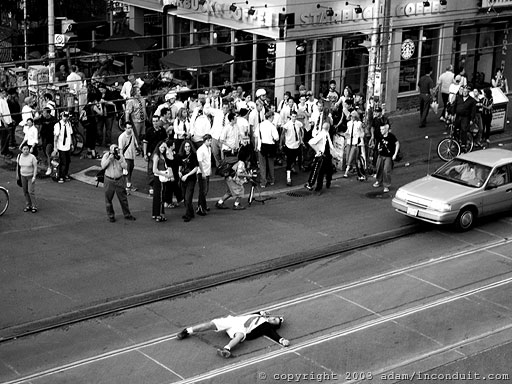
I took my pants off on Bloor St. today. It was pretty chilly.

Here’s my ridiculous, rushed attempt at recreating some iconic Breaking Bad imagery. How’d I do?

“Let’s cook!”
—outside the Breaking Bad RV 
The classic image from the first episode of the series:
Walter White in his tighty-whiteys.

I didn’t have a lot of time to get it done, but—sometimes you just do things for a laugh.


Walt and Jesse’s first lab rolls through town
The highly-recognizable camper from the hit AMC television series Breaking Bad was appearing in various places around the city, as a promotional marketing push accompanying the release on DVD/Blu-Ray.

The tour is being touted on Facebook and Twitter as:
“Your chance to interact with the vehicle used as Walt and Jesse’s first lab and where the story began.”
I saw a whole series of photographs of people posing around and inside the camper wearing yellow Haz-Mat suits. My immediate reaction as a fan of the show was, those shots aren’t authentic!

Oh dear.
The yellow suits are from later seasons of Breaking Bad.

When Walt and Jesse cook in the camper during the first season, they’re basically only wearing green aprons and gas masks. Having the yellow suits around violates the continuity—which is important if you’re a true geek like yours truly. It’s just wrong.*

So I thought I’d do my own guerilla shoot, after discovering where the camper was appearing today. The result is as above.

“I just want you to know, no matter how it may look, I only had you in my heart.”

Green shirt: check. Facial hair & glasses: check. [Dollar store] Gun: check. Tighty-whiteys and argyle socks: check!

Note to Sony overlords: the onsite staff explicitly told me that they “could not condone” the shot and they refused to assist me in any way (though they didn’t interfere, either). You could tell them they should’ve embraced the fan spirit and helped out!

It’s amusing that the subject material of the show is so incredibly graphic, yet when it comes to marketing, any hint of edginess is verboten. For heaven’s sake, you are pretending to cook meth inside the camper, as part of this promo campaign! A guy standing outside in his underwear isn’t going to get you fired. It’s a funny set of standards to uphold, don’t you think?

The yellow suits are fun, but...
And nevermind the barrels.

Thanks to random-passerby ‘Alex’ for taking the photos. Several people I asked were not comfortable—as soon as I mentioned I was going to remove my pants, they declined, duh—which I found unsurprising but still interesting from a cultural perspective. It’s just underwear, folks. But the schoolyard taboo remains strong.

If any photoshoppers out there want to help me make this a little more ludicrous with effects or messing around with the hues/saturation, please be my guest. It’s rather incongruous to have ‘Holt Renfrew’ in the background instead of the desert...

* In season 2 episodes 5 and 9 Walt and Jesse do wear pale grey zip up 'clean suits'. But the bright yellow suits are from season 3 episode 6 onward...

Beyond The Pink: The Subversion Of Barbie

Image: Barbie is a modern doll with a classic sensibility
Barbie: “A modern doll
with a classic sensibility”
Barbie is iconic.

Ubiquitous, and evocative, she is an inscrutable Mona Lisa for our times. Her pink-themed branding aggressively colonizes entire sections of every mainstream toy store.

Critics have decried the doll’s image for the 50 years of her existence. Yet her glamorous power endures within our cultural topography.
“Women my age know whom to blame for our own self-loathing, eating disorders and distorted body image: Barbie.” 
- Amy Dickinson, Time Magazine

The Iron Maiden of The Beauty Myth?

Barbie for President:
‘Iron Maiden’ or
aspirational?
In her best-selling feminist work, The Beauty Myth, Naomi Wolf describes the pernicious effects emanating from a widespread societal obsession with a coercive ideal of feminine appearance.

In Wolf’s view, the mis-proportioned figure of Barbara Millicent Roberts almost certainly embodies this malign ideal -- an unrealistic ‘iron maiden’ from which young women struggle to escape.

Meanwhile, Mattel, the maker of the doll, brightly and optimistically casts Barbie as an empowering, aspirational model -- a toy manifestation of the American dream where any identity is possible.

Which view is correct?

Iconoclasts and Subversion

Tom Forsythe was famously sued by Mattel, for his absurdist Food Chain Barbie photographic series. His challenging legal journey opened the path for other artists to freely experiment with Barbie-themed images, without fear of litigation.

Fondue For Three - Tom Forsythe
This series sparked a 5 year legal battle with Mattel
over fair use, free speech and artistic expression

I want to mention and share the work of several such artists, each of whom leverages and re-mixes the standard portrayal of Barbie in some way. The sequence progresses from coy and conventional, through to a much darker world view.

These images form entry points for reflection on our deeply persistent cultural relationship with Barbie. Our understanding of her turns out to be as mutable as the clothes she wears.

Barbie’s Wedding

Beatrice De Guigne captures “Barbie and Ken’s Wedding” through the ironic lens of an actual wedding photographer...

Beatrice De Guigne’s Wedding Photography
Click here to view series

This series is kind of cute, even saccharine, and is more of a playful take on stereotypical wedding photos, than it is a commentary on the Barbie universe. But this naturally leads to the question, “What happens after the wedding?”

The next two photographers suggest some possible, not entirely happy answers...

in the dollhouse

Dina Goldstein’s ‘in the dollhouse’ series features real-life models posed as Barbie and Ken.

It purports to examine ‘the less than perfect life of B and K. B is a super doll, the most successful doll in the world. Her partner K is grappling with his sexuality and finds himself in a loveless marriage. He struggles with his position in the household and faces his lack of authenticity.’

Dina Goldstein’s ‘in the dollhouse’: an unhappy marriage?
Click here to view series

Check out Dina Goldstein’s ‘in the dollhouse’.

Goldstein is most well known for her Fallen Princesses project, which creatively imagines less-than-idyllic scenes of post-fairy-tale life.

Mariel Clayton: Disturbing Yet Funny

Mariel Clayton’s work takes the Barbie aesthetic, and corrupts it. The results are disturbing, incorporating elements of sexuality and grisly force.

Ontario-based Clayon’s meticulously arranged dioramas often show the aftermath of violence. Barbie exists, in this world, as a smart, sexy, psychotic -- in control of herself and the situation -- rather than as a vapid materialist concerned solely with clothes and fashion.

Mariel Clayton: Grim humour amidst banal clutter
Click here to view more

WARNING: SCENES OF VIOLENCE AND SEXUALITY.

I particularly appreciate the careful detailing of each photograph. Clayton’s rooms are filled with the banal clutter of domesticity, a mundane backdrop to the turbulence elsewhere in the scene.

We are drawn into a fantastic and gruesome world where Barbie has taken matters into her own hands — a world where she has liberated herself from the drudgery of her consumer existence. The message is anarchic. Irreverent. And, I think, delightful.

Mariel Clayton’s work on Facebook
Mariel Clayton’s website

Barbie: She Is Us

profile image of Barbie
Barbie: a fascinating figure
Barbie influences -- and represents -- our cultural values in many ways, whether we approve or not. She is our Madison Avenue Madonna, our corporate-generated Venus. She is a fascinating figure, at once the subject and object of artistic critical interpretation.

500 years from now, historians and anthropologists will study the doll, and her endless accessories, as valuable indicators of our fashions, social institutions, customs and mores (A visit to Barbie’s Facebook page or her YouTube channel is remarkably instructive).

What is your opinion of Barbie? If you are a woman, did you play with Barbie as a child, and how did you interact with the doll? If you are a man, to what extent did Barbie shape your impression of feminine beauty? What role, if any, did Barbie have in forming your expectations of gender norms?

If you are a parent -- are you going to buy Barbie for your children, or will you attempt to shield them from ‘princess’ culture?

[LINK: Aqua - Barbie Girl]

Bonus Barbie: What would Barbie look like as an average woman?

Nickolay Lamm recently released a short set of of photos depicting a normally proportioned Barbie that he fashioned using a 3D printed model (based on CDC measurements of an average 19 year old American woman). The contrast is striking.

Nickolay Lamm's 'average Barbie'.
Click here to view more.

Lamm discusses the process he undertook to create this version here.

See Also

Barbie.com (Official Barbie site)
Barbie History
Life In Plastic (The Economist)

Interview with Iyma Lamarche, Part Two!

Welcome to the second half of my interview with Iyma Lamarche, Canadian rock climber. (To read the first half, click here. To listen to our conversation, scroll to the bottom!) Enjoy!

Iyma about to send at the 2012 Canadian Bouldering Championship
Photo: Nic Charron

------------------------------------------------------------------------------------

Interview with Iyma, Part Two

Do you have a particular technique, or strategy for focusing? How do you deal with the pressure of the moment?

Generally I listen to a lot of music and... actually I do something recently that I saw -- I don’t even know if this is what he was doing, but when I was at Bouldering Nationals in Montreal this past year... I saw Mark Button sitting in his chair, and he had his eyes closed, and my dad was like, ‘look at him, he’s not even moving!’

Mark Button has posture. (TdB Eastern Regionals @ Altitude)
Photo: Nathan Ng

I looked over and he’s sitting in his chair, and he looked like he was sitting on the beach. It was ridiculous. And he was completely still, and his breathing was so slow, and it was beautiful. And he’s the most relaxed climber ever, you watch him climb and it looks like he’s just playing around. It’s ridiculous.

So I actually took that, and I tried it at Youth Nationals. I just sat, and I literally -- I know people say, ‘concentrate on your breathing’ and it’s so -- I’m always like, ‘ok, I don’t understand’, and then I did it.

Iyma practicing her relaxation prior to
W3 Finals, TdB @ Coyote Feb '12
Photo: Nathan Ng
I was trying to do what it looked like Mark was doing -- I don’t even know if that’s he was doing -- but I sat, and I breathed really, really deeply.

I tried to breathe as slow as I possibly could, to take the air in as slowly as I could, and I have never been as calm as I was, after I did that. So from then on... my calming-down focusing thing has been to sit down, put my music in my ears, and breathe really deeply.

And climbing. The warmup is essential for me, because it also gets rid of my nerves. So I just do a lot of traversing. If I’m feeling a little jittery, and I can’t sit still.

What’s the next big event that you’re going to be training for?

A wrist injury at Joe’s last year
Photo: Aaron Eden
At the moment -- well, Atlanta was my ‘finale’ for the year, for last year, and then I’ve been training in preparation for the beginning of the Youth season, and Tour de Bloc. The Tour de Bloc at Joe’s is my first comp for the year. We’ll see how that goes. Last year I injured my wrist at it. Hopefully it goes better than that one!

You still made finals in that one, didn’t you?

Oh -- I injured it in finals, so hopefully it goes better. I’ve just been preparing for the beginning of this season. At this time of year usually is where I get my training peak.

Kicking off TdB season 10
Iyma made finals, placed 2nd at Joe’s
Photo: Aidas Odonelis
So I get to my best just right before this comp, and then it kind of levels out. And then I peak again at internationals. At the moment, I’m just gearing towards getting better.

[N: This year she wound up making finals again]

And then, Tour de Bloc and all that regular stuff, and then the next kind of big one will be Tour de Bloc Nationals in May or whatever.

Do you ever find that there’s a tension between the enjoyment of climbing and the competition aspect? Because almost all of us climb because, you know, we love it --

Yes.

-- We enjoy the physicality of it, we enjoy the beauty of the motion, the adrenaline of going higher and not falling off, the satisfaction of figuring out a problem or sequence -- But at a comp, there’s this other dimension involved, the competition --

Yes! Absolutely.

Do you find there’s a tension there -- how do you reconcile that?

Enjoying the beauty of climbing
2011 European Youth Championship, Austria
Photo: Pam Eveleigh
The reason why competition climbing works for me, is that I’m not very competitive with other people. I don’t hold a lot of... tension, or threat towards other competitors. So in terms of my relationship with other competitors at comps, that’s pretty neutral. Where it gets --

-- You don’t have any rivalries?

Not really, no, not at all! Maybe other people have rivalries with me! But I’m pretty calm.

Like when I climb, I’m always trying to beat Pia [Graham, another youth competitor].

[Laughter] That’s hilarious.

If I have an amazing day and she has a crappy one, I can just barely squeak in...

[laughter]

I just push myself with other people. If I see someone doing something really awesome, then I think maybe it’s going to be a bit harder for me. It motivates me. Where I get my issue and my competitive edge, where I can get a little bit stressed out and forget about why I’m there, is when I pressure myself or self-doubt...

For me the line in competition -- it’s more about just myself, self-talk, and what I expect from myself, my own expectations.

Climbing: a personal experience
Photo: Aaron Eden

That echoes -- I read a recent post from Elise Sethna; she commented the same thing: she finished in a certain place, but what governed whether she was happy or not was how she thought she did --

Exactly.

Like, never mind the rankings -- did she do the absolute best she could do on that day?

I think that’s a really important one actually, it’s just to be happy with your climbing. I mean, focusing on results is pretty much useless. If you climb your best, and you’re super strong then you’re gonna win.

It’s not, you can’t really... you can’t judge that because someone might have an insanely good day, you might have a bad day -- it’s hard with competitions like that, because climbing is such an individual sport, and so self-governed --

-- Personal --

It’s super-personal, and people take it personally a lot of the time, when they don’t beat people, or don’t feel like they did their best. Which is where that kind of competitive edge comes in, and I think that it’s really important to keep that out of there, and focus on your own performance, and if you think you did your best --

For me, the only competitive edge comes when I feel like I haven’t done my best, or if I’m putting pressure on myself.

[LINK: TdB Local @ True North, Women’s Finals. Footage courtesy Matthew Tee]


Do you pressure yourself to succeed?


The pressure obviously increases, as the competition increases. Or as my focus on a particular competition increases. I try to keep the pressure off unless, unless I’ve been training for something all summer, or if, you know, something like that, I definitely put pressure on myself. I try to make sure that that isn’t going to stop me from succeeding. I place a lot of importance on things, but I don’t necessarily scare myself off the wall.

Yeah. I put pressure on myself, but I think it’s positive.

Do you think that that is necessary in an elite athlete? I read an Angie Payne interview a while back, where she was describing a near obsessive training season, where she was compelled to send this particular problem, some v13 or whatever, and she basically spent a month doing this thing again and again and again, and it just seemed so painful. As an outsider it seemed like, ‘are you actually enjoying that?’

I was wondering, how do you --

It takes a certain type of person to enjoy that. It comes a lot from who you are, and it comes a lot from... competing, to me, has gone past -- I know people say ‘all that matters is if you had fun’, but for me, I know I’m going to have fun either way, it’s not about that -- it’s about the competition, and it’s about pushing and it’s about sending the route, and it’s about that.

It’s competitive. You’re there to win, you’re there to qualify, whatever you’re there to do -- you have goals and you’re there to achieve them. It goes past... obviously Angie’s a motivated person, she’s done some crazy stuff. It goes past the having fun part. I think it’s a given. You’re having fun, but the fun comes sometimes from pushing yourself. It’s necessary. I think people on the outside definitely look at it as, ‘why would you do that to yourself?’, but for me inside, it’s because -- I love it.

Photo: Dennis Barnes
Do you find it odd cheering for the other competitors? Because you never want someone to fall off, but at the same time, you have to do more in less attempts...

I think I’ve gotten to a point where I really can just appreciate other people for what they do. You know, they’re not you, and you did all you could to be there. So I think that the cheering part has gotten, like, I just cheer for everyone. Because there’s really no point in wishing for them to fall, because they’re going to do whatever they’re going to do, and whether or not that means kicking you out of finals or beating you or winning, like, that’s their own thing. You already had a chance, or maybe you haven’t had a chance yet.

You use that as motivation, or something that makes you depressed -- it’s your choice. It just depends on how you decide to look at that person, whether or not you look at them as a threat or as a competitor or as a teammate, like a peer... I try to look at all my competitors as peers, or as people who I look up to, as role models.

I cheer for everyone.

I want to shift to women and climbing.

Yes.

In many ways, it’s still a male-dominated sport. Are you conscious of being a role model for other female climbers -- younger and older?

Well -- I have three little sisters. So I’m definitely conscious of being a female in the sport. But I think that part of the way to break that barrier, and to break that kind of ‘men-only’ trend, is to not even really acknowledge the fact, and just, you know, participate with both genders, and to get women into it, as much as you get men into it.

“I’m a woman and I’m happy about that.”
Photo: Dennis Barnes

Because I think that to single out women, and say ‘women you need to get involved’, or ‘we are the minority’ is to encourage it, and I think that an important thing is for all the women and girls that are interested in the sport to just pursue it, and not take that as a threat, or think, ‘oh, maybe I shouldn’t, there’s only men’.

I go on climbing trips with all guys all the time! It’s mostly just guys, but that’s fine; I’m a woman and I’m happy about that, but I’m not going to look at it as like, ‘oh I feel so threatened because I’m the only female.’ I mean, women are getting in there, and it’s happening. It’s not like it’s not going to happen.

This might be stupid but -- I’m going to ask anyway --

Yes --

2011 World Youth Championships
Photo: Pam Eveleigh
Do guys give you a hard time at the gym -- and then back off when they realize you’re a better climber than them?

Oh, all the time. I think the worst is actually... It actually does really affect -- or at least it did -- not my self-esteem, but I would always kind of notice it, and it’s frustrating, is when, you know, pfft, guys, random guys, will come up to our finals problems.

And the women’s finals problems are always the first ones that the guys try. And they’re always, ‘psht, can’t be that hard’, and whatever, and they fall. Or they do it, and that makes it even worse. But then they’re like, ‘oh, it’s not that hard, the girls did it’.

And it’s like -- you know, come on. We try really hard to be here. And being a woman in climbing doesn’t mean that you’re weaker in climbing. And it definitely doesn’t mean that your problems are easier in climbing. I mean, even the guys who look at me in the gym, same sort of thing at my training, like ‘pssht, she can’t be that good’ -- that’s definitely a frustrating aspect of it.

I think that’s the most frustrating thing about being a woman in climbing, those guys who... expect it to be ‘not as hard’ because you’re a girl. I think that is definitely something that needs to change. And it will change as the sport matures. But it’s frustrating.

Do you get a lot of unwanted male attention at the gym?

Sometimes! I think it’s sometimes different for me, because my dad owns the gym and I’m like, ‘hey dad’, and everyone kind of backs off, but when he’s not there... yeah. I mean, guys are weird that way. But boys will be boys, and that kind of thing happens. It can be frustrating, because it can be a bit... not a distraction, because I’m not necessarily entertaining it, but just like, c’mon, I’m trying to do something here. I’m working hard. Like, get out!

So it’s hard.

Pssht. She can’t be that good.
(SSF ‘12 Women’s Finals, en route to victory)
Photo: Nathan Ng

More seriously, do you think that women climb differently than men, or rather learn to climb differently than men?

I have noticed I’m not a very feminine-styled climber. I don’t have the same kind of physical traits as a lot of women do. It has a lot to do with our own centre of gravity and our own body shape. Women use their hips a lot more, and are definitely a bit more technical, and generally it seems that women are better at balancy styles -- and not necessarily as strong in the upper body department.

But then you have people like Alex Puccio, who are like, crazy burly. In general, yeah, women are stronger in terms of the technical, more balancy aspects of climbing. That just comes with how women are built.

Wackiness in the cave
Photo: Andrew McBurney

For me, it’s not like that. I’m better in super-overhanging areas with very shouldery moves. Because my upper body is enormously more strong than my lower body -- or than my hips, at least. It depends on the person, but generally I think women climb differently than men, in what they’re better at. Not to say that women couldn’t be good at the same problems as men -- but yeah, I think there’s a difference for sure.

[N: of tangential interest: this article by Thomasina Pidgeon on competition]

Next topic -- the future. Lead climbing is on the shortlist for new sports for the 2020 Olympics. The IFSC is making a pitch and they’re making a decision next year. Now... if your developmental trend continues... AND they actually get on the list... it’s not entirely implausible to imagine you, at the peak of your physical prime, representing Canada. There’s an outside chance of that, anyway.

Is that something you would aspire to? How would you feel about participating?

Since I’ve been really small, I’ve really admired the Olympics. I’ve looked up to the athletes. I’ve always wanted to go since I was very small. I’ve always wanted to go -- never knew what sport, I never knew what I would do, and now that climbing... there’s a possibility that it might make it into the Olympics -- that’s fantastic for me.

I understand where people are coming from with the whole, ‘climbing isn’t a sport for the Olympics’ or ‘it’s not commercial enough’ or ‘climbing is too much of an individual journey in itself’ -- those are all things that I appreciate about climbing -- but I also think that it would do some fantastic things for the sport. And I don’t think it would change necessarily the nature of the sport.

Citius, Altius, Fortius...

I don’t think it would change the spirituality about the sport. I think that people look at it differently, and maybe would look at it differently if it were in the Olympics -- which could be negative or positive. For me at least, it would be pretty fantastic.

It would have a positive impact?

There are both harmful and positive things that could come out of the sport becoming more popular. It’s pretty selfish, but in terms of my own wishes, and my own -- what I’ve aspired to -- I think it would be awesome!

What do you think that we have to do -- Canada -- to get to the next level of accomplishment? If you look at a country like, France or something, they have a fairly large --

Austria -- it’s like the national sport!

I think a) it has a lot to do with popularity, b) our country is pretty huge, and it’s spread apart -- the two general climbing communities of the East and West. For Canada to move forward, in competition climbing, especially, we need to get the Prairies a lot more involved -- if they want to, you know -- but I definitely think that we need to involve more of the country as a whole. And look at all of us.

There’s a bit of separation between the East and the West, and I don’t necessarily think it’s positive. That needs to change -- there’s too big of a separation. We don’t look at each other as equals. Which is unfortunate, and I wish it were different.

The East is younger at the sport -- in terms of competition climbing, which is sad, but that’s how it works, and I think that if we were all just a bit more accepting of the fact that we’re separated by a lot of land, that doesn’t necessarily mean that we have to be separated by beliefs, and the way that we climb, and who we are as people.

We just need to connect a little bit more, and get more people involved, and be more positive, and not have any kind of disagreements, or hatred, or competitiveness towards each other.

East and West on Team Canada in 2010
Photo: Gail Adamson

Does there need to be more funding for youth programs?

There needs to be more funding for climbing in general! Is that realistic? It would be nice if it were a nationally funded sport. It would take a lot of pressure off of the people going to Worlds, and the people competing at Nationals, and even just the kids who are interested in Youth programs in general. Not even just the youth -- the Open team, they have a lot of struggles with competing too, because it’s expensive.

-- just to get there --

And we get no funding! It’s expensive for the uniform, getting there, the hotels -- it really adds up. That’s detrimental to the sport as well.

Side question -- speed climbing. Silly or cool.

Oh, speed climbing’s great! It’s fine for what it is. I mean, I never do it.

It just looks so weird!

It does, it looks funny.

I can appreciate what they’re doing -- but at the same time, it looks goofy.

Yeah. It’s not that I don’t have an appreciation for it. I totally understand why people do it. It’s not what I value in climbing. I’m a technical person, and I enjoy the beauty of climbing. Speed is beautiful in its own way, but... I don’t necessarily agree with it, for me. But I think that the fact that Canada is making its step forward in speed climbing is super positive, and I think it’s absolutely fantastic. It’s awesome.

A little closer in time, there’s an effort underway to bring an IFSC World Cup to Toronto. Does that excite you?

Will Toronto get an IFSC
Bouldering World Cup in 2013?
Oh yeah! It excites me a lot.

Would you want to compete on home turf, and represent Canada?

It would be nice if it were a lead World Cup but...

Or would you want to travel?

No! It would be nice to have it here, to bring family and even friends, let people know about it, but I think it will do a lot for the sport in Canada, especially to have it in the East... I think that’s going to be great, if that ends up happening. That would be cool for sure.

All right. Home stretch. Personal topics...

Yes.

Canadian climbing power couple
You’re going out with Eric Sethna?

I am. Yes.

You guys are like a Canadian climbing power couple. Discuss.


[laughter] Some people say that. Yeah.

You train with him, right?

He’s in the co-op program at Waterloo in engineering. So when he’s on his co-op term, generally right now he comes to Toronto, and we train for the four months that he’s in Toronto together. And then, when he goes back to Waterloo, he’s on the Grand River Rocks team. Obviously our climbing is very... tied, like we climb a lot together, but not necessarily train together when he’s back at school.

Are you guys competitive?

[Laughs] We push each other. We have opposite strengths for sure. We play off each other’s strengths, we try to challenge each other as much as we can, it gets pretty funny sometimes. But it’s all fun. It’s all fun.

He’s quite an accomplished climber in his own right, so --

Absolutely -- he’s very strong. A very strong climber. I learn a lot from him. He teaches me a lot about my own climbing even, just about my style, and, you know, what kind of techniques are easiest for me, what makes things harder. I’ve learned a lot from him in climbing. I think I’ve learned more from him in climbing than I had been for -- it’s really positive, our relationship around climbing.

Iyma and Eric climbing together in Atlanta

I’d like to talk about your longer term goals. Career interests, for example. What do you want to be ‘when you grow up’?

In terms of what I want to be, I’ve always had a struggle with that. I’ve always liked everything, that I kind of do, so it’s been hard. I’m not necessarily really great at one thing, which can make it harder at some points in time. I tell people that, and they’re like ‘oh you should just be happy that you’re not only good at one thing’ and that’s true, but it’s very hard to pick and choose what area I want to go into.

I’m looking into a program at Laurier, that is based on anthropology and psychology and English. Which are my three main interests at the moment. I love writing, and I love psychology. We’ll see where that takes me -- I’m pretty open to switching career paths, but in terms of where climbing fits into that -- when I was a kid it was ‘I’m going to be a professional climber!’

Many elite athletes face a choice...

-- between pursuing that --

And school. Where do you...

Travel in the future?
photo: Iyma Lamarche
I definitely want to go to university. But I may end up taking a year or two to just climb. I definitely need it. I think that it would do a lot for me, to keep climbing in my life. I mean, climbing will always be in my life, but just to really strengthen that.

But -- in terms of do I want to be a professional climber? No. Probably not.

Back to the most general question -- why do you climb? Tell me what climbing means to you.

I started climbing because -- honestly, I think I started climbing because I had a propensity for it. But I’ve continued climbing, because it’s something for myself. I’m an introverted person, in terms of my own self-reflection... I don’t necessarily love team sports. But I’ve always been a very athletic person.

Onward and Upward
for Ms. Lamarche...
Photo: France Lavoie
Climbing embodies what I appreciate about athletics, as well as what I appreciate about being by myself, and solving my own problems for myself.

It’s very personal for me. It means that I get to do a lot of self-reflection, and learn a lot about myself, through a sport. That’s a huge, huge motivating factor.

And also, it’s just so fun!

It’s so exciting. It’s a great sport. And it’s physically demanding, it’s mentally demanding, it’s a smart sport, you know.

It requires thought, which I appreciate, and for me it means peace. It means focus. It’s a meditation for me to climb.

We’ll finish things off with a lightning round. Short answer, first thing that comes to mind. Favorite movie?

Ah - One second. The first thing that came to mind is Tarzan! But that’s actually accurate. I love Tarzan.

Author or book? Michael Ondaatje. In the Skin of a Lion.

Best music to climb to? Rap.

Climbing shoe size? Four.

Brand? Sportiva.

Harness? Arcteryx.

Chalk. Flashed, all the way.

Do you use -- Actually liquid chalk, Mammut.

Complete the sentence. Climbing makes you: Happy. That’s so generic!

If you could only go to one event this year, it would be: Route Nationals.

Favorite fruit? Strawberries.

Excellent. Any other comments you’d like to share? 

Mmmm. I don’t only eat healthy. I love Nutella.

Nutella?

It’s like, my vice. Serious. I can’t get enough of it! I don’t want people to think I’m some health freak. Well, that’s not a bad thing. But I love Nutella.

Other interests?

I love reading. I love literature. And I love writing.

And I love family and people. I love spending time with them. I’m a people person, but I’m not. It’s weird.

I’m introverted, but I love spending time with people. I’m an oddball a bit I think. But that’s ok -- we all are.

Thank you so much for your time!

That was fun!


 [LINK: Iyma discusses climbing and music. Footage courtesy Dale Sood]


------------------------------------------------------------------------------------

Audio Bonus: Listen to Part 2 of Our Conversation


[Use THIS LINK if the above doesn’t work in your browser]

------------------------------------------------------------------------------------

Thanks and Acknowledgements

Thanks of course to Ms. Lamarche for graciously enduring my random questions, and to her parents for their support.

I also would like to thank the numerous people who generously consented to the use of their photographs and footage for this interview, including: Gail Adamson, Dennis Barnes, Nic Charron, Aaron Eden, Pam Eveleigh, G6 Climbing, Will Hummel, Iyma Lamarche, France Lavoie, Mike Makischuk, Meagan and Aidas Odonelis of (Ruby Photography), Dale Sood, Matthew Tee, and Lauren Watson.

Going for it!
Photo: Nic Charron

Please share this post if you liked it!!

See Also

Onward and Upward (Iyma Lamarche’s blog)
Iyma on Twitter
IFSC Competitor Record: Iyma Lamarche

Other thematically related pieces:
My series of posts on competing at the Tour de Bloc
Interview with Rock Oasis’ Founder and President
Profile: Justin Readings, Downhill Skateboarder

What Happens When You Cross Party Rock Anthem With Who Let The Dogs Out

Perhaps it’s just me, but the exuberant Korean viral sensation Gangnam Style by PSY sounds familiar. It’s kinda overplayed now, but I nevertheless really enjoy the video’s satirical, over-the-top insouciance.


I was wondering whether anyone else hears the same auditory likeness that I do? Listen to the catchy buildup and release to the main hook from Gangnam style -- and by ‘hook’ I mean “that chunk of the song that everybody knows and that everybody sings along with, and if you’re on the dance floor you go crazy to it”:

Oppa Gangnam Style - Main hook (~2:23 in; listen for about 20 seconds, then come back)

Compare that with the buildup and hook from LFMAO:

Party Rock Anthem - Every Day I’m Shufflin’ hook (~3:30 in)

And then throw in the syncopated ‘woof!’ chant of Who Let the Dogs Out?... Can you deny the rhythmic similitude to:

“Op, op, op, op... Oppa Gangnam Style”?

I’m not suggesting that they’re the same, or that PSY is in any way derivative. But I think it’s interesting to notice the commonality between these three pop culture hits. What is it about that particular structure of off-beats and pauses that makes it so instantly appealing?

I’d love to hear from anyone who has studied music theory on this.

Update
Turns out I’m not the only one who thinks there is a structural similarity to Party Rock. Check out this mashup:


Some background info here.

The Toronto Board Meeting: A Short History

The First Board Meeting in ’03
Photo: Nick Clayton
The Toronto Board Meeting is a chaotic annual gathering of skateboarders from all over. It primarily takes the form of a joyful, rumbling mass cruise through the streets of our fair city. You’re invited!

This year will be the 10th iteration of this sprawling and shambolic event, celebrating the fun and freedom of shredding on pavement.

Let’s take a look back at the forgotten history of this Toronto skate tradition -- but first, here are some details about this year’s ride:

Where and When
The 2012 Toronto Board Meeting is taking place Saturday September 8th at 3pm.

2012 Toronto Board Meeting Poster


Meeting location: David A. Balfour park. Go to St. Clair subway station and head 2 minutes south-east to the park. Look for about a thousand skaters mingling on the grass.

Lookin’ sharp Nat... (BM ’04)
Photo: Jon Nuss
Dress Code: collared shirt and tie. Fashionistas may disagree, but a white shirt is preferable. AND WEAR A HELMET!

Attendance is free. It will be huge, fun, and insane [but also mellow, in pace and vibe].

The route heads downtown -- last year’s was like this -- and typically rambles around for a couple of hours, before coming to a close in Kensington Market (the end may change).

The notorious (and optional) hill drop at the start south of St. Clair is the Torontonian skate version of ‘running with the bulls’ -- thrilling, messy, and there’s inevitably carnage each year. The hill itself is no big deal; skating it while surrounded by a hundred unpredictable n00bs, on the other hand, is an adventure.

P.S. rumour has it there will be a ton of prizes and free swag...

The Board Meeting Chant - aka ‘Corned Beef’
‘Corrrrrrrrnnnned Beeeeeeefff!’
During the ride, as you roll past onlookers, it’s customary to make some noise and yell out ‘Booooaaaard Meeeet!!!’ to inform people of what’s going on.

If you prefer, however, the substitute expression ‘Coorrnned Beef!!!’ may also be used -- and sounds roughly about the same, presumably due to the Doppler effect, and the vagaries of sound transmission.

After Party & Slide Fu
An event as massive as the Board Meeting tends to spawn off corollary happenings. This year’s bombastic After Party will take place at the Annex Live, 296 Brunswick Ave; doors open at 9pm (19+, sorry groms).

I have heard that there may be alcohol involved. Ahem.

The following afternoon, Slide Fu takes over the Poop Chute. It’s an epic, steezy, and hung-over slide-session. 2pm skate time.

Slide Fu brought to you by Escarpment Surfers and Skate Invaders

When your skate session has sponsors, you know things are a bit crazy! :) And if you don’t know where the Poop Chute is, come to the Board Meeting and find out!


Bonus - Highway Gospel Skate Documentary Screening 
The critically acclaimed documentary skate film, Highway Gospel will be screening at the Royal Cinema the night before the Board Meeting. Here’s a coupon for free admission!

Right-click-save & Print this off for admission to Highway Gospel at the Royal Cinema Friday Sept 7 at 7pm!

A Short History of the Toronto Board Meeting
Here’s the one-minute origin story of the Board Meeting, as told by its founder, Benjamin Jordan (aka ‘Jacob Furlong’):


BM Origin Story


A Slightly More-Convoluted Retelling That Isn’t 100% True
But Is Likely Close Enough 

In the early 2000s, Michael Brooke -- the publisher of Concrete Wave -- and Tom Browne -- Brooke’s erstwhile business partner on CW’s predecessor publication, International Longboarder -- were holding open-to-anyone longboarding cruises on alternate Sunday mornings, meeting up at Hogtown Extreme Sports.

They called themselves the Metro Longboarders.

Jordan exhorts the troops, BM ’03
Photo: Nick Clayton
The story goes that Jordan, a dynamic commercial photographer, loved going to the sessions, and riding with other people, but hated getting up in the mornings to attend.

In mid-2003 he was taking a course in self-expression, and there was a community leadership module he was completing. The module required him to “give something back” to a community he identified with.

Mixed together, these elements inspired Jordan to create an occasion that combined his passion for longboarding in a pack, with the artistic expression he enjoyed through photography.

He had a vision: a fluid mass of skaters -- all wearing business suits -- coasting down Yonge Street, having fun. Along the way, photographers would capture the mayhem.

Photo: Kid With Camera
It would be “a community created from nothing.”  Flash-mobs had been popularized that summer, and Jordan’s idea meshed right in with that aesthetic.

A date was scheduled, and flyers were plastered up around downtown. Unlike the groggy Metro sessions, Jordan’s event would happen in the afternoon.

The whole thing was nearly derailed by the wandering eye of law enforcement. Some anonymous killjoy brought the flyers to the attention of the Toronto Police Service, and they contacted Jordan to inquire about it. Skateboarding on the road is illegal in Toronto.

Was he the organizer? they asked. No, he had “delegated the project to someone else” and “wouldn’t hold such an event in their jurisdiction.” This gave rise to the pseudonym, ‘Jacob Furlong’, who henceforth became the nominal organizer for the event.

The Board Meeting went ahead -- albeit somewhat furtively -- and the rest was history.


Jonathan Nuss’ Board Meeting Photography
Jonathan Nuss, a good friend of Jordan’s, helped coordinate and photograph the event. Nuss’s accumulated skate images tell a remarkable story of the Toronto longboarding community over the years.

Right after this we took over Queen and John for the first time...
Photo: Jonathan Nuss

Describing the Board Meeting, Nuss writes:
...this is my favorite thing to shoot in the world.
Longboarders skating down yonge street during rush hour traffic to take back the streets. To help promote longboarding, alternative transportation, and freedom to skate with no dollar sign attached to it. My good friend ben pulled me out to starbucks to listen to him rant like usual. ;-) This time he had a great idea, he called it the boardmeeting. He had a dream where people skate boarded to work instead of taking their cars. He asked me to help organize the photographers for it.
Taking over Yonge St: A magazine-worthy shot?
Photo: Jonathan Nuss
It was my first year of humber college and i got a bunch of my friends together to help shoot the event. The idea was to shoot everything in black in white film, process that night, and then ben would go to new york for a gallery showing. We didn’t other years we just shot it any old way but bw is still the theme mostly. I wasn’t a very good skater at the time so i rode my bike... later years i found it was much more fun to be a part of it... as my confdence grew as a photographer and longboarder.
We spent two days flyering everywere for the event.. and had no idea who would show up, or if anyone would bother even coming. 60 people showed up... the next year 100... the next year 140... the next year almost 200... I like to call it living art... and over the years it became more then ben and I. It was complete strangers showing each other love for no reason other than to skateboard really fast... 

My First Board Meeting 
While standing at the Queen and Spadina streetcar stop, I noticed a poster for the first Board Meeting. The white poster read, “Bomb Yonge St. Like It’s Never Been Bombed Before!”

Yours truly (2nd from right) at the first Board Meeting.
This photo ran in the Globe. Photo: Adam K.

I was intrigued. What an awesome idea, I thought. I’d skated for a few years, but never really got to know anyone. So when the day came, I put on a shirt and tie, and hoped I might meet some new friends.

To my surprise, everybody had longboards, which were kind of novel at the time -- at least to me, anyway. All I had was my regular popsicle-stick skateboard.

People were nervous about the police. The gathering spot was changed at the last minute, to throw off the scent. Someone asked if I’d left my ID at home. The general escape plan was quaintly Darwinan: if there were enough skaters, the police wouldn’t be able to catch all of us.

Heading off to ‘work’
Photo: Greg

The excitement mounted as more and more of us showed up in the parking lot. Nobody violated the dress code. We took a few photos in front of an office building, and then it was time to go!

We bunched up on the sidewalk, and waited for the lights to turn red on Yonge, before making our move. Ben gave us the signal to occupy the road for our own and we did. People sat dumbfounded in their cars staring at us. We started to roll with a ragged cheer... It was a thrill to ride with so many others. The rumble of urethane was like a growl of rising thunder. And then -- the perilous descent.

The very last skater! (ahem)
Photo: Nick Clayton
I had never bombed a serious hill before. Turns out, a short deck at speed is ridiculously squirrelly! I got to a certain velocity and then -- I had to jump off to avoid totally wiping out and smashing myself on the road. Everyone zoomed past, ever downwards, hooting and hollering.

I took the rest of the hill in another go. Traffic was light that day, thank goodness. It was so sketchy. But I managed to get down to the bottom without getting killed. I could see the others dwindling in the distance, finally disappearing. I pushed like hell and finally, finally caught up to the crew -- at Queen and John!

One...
Photo: Adam K.

It was an incredible, powerful feeling to skate with a group like that. “An electric experience,” Joker once said. It felt like we had taken ownership of the streets, for a while. But only for a while. Oh, how we laughed and scattered when that cop cruiser wound up its siren and booted us from in front of Much Music!

Many.
Photo: Adam K.

Phenomenal Growth
Keeper of the flame:
Chicken
Photo: Jon Nuss
In the following years, Jordan passed on the mantle of responsibility to others, and the Board Meeting exploded well past his initial concept and scope.

Last year before the Meet I ran into Ben, and teased him about kicking the whole thing off. He shrugged and said, with his characteristic modesty, “This is waaaay beyond me. I caused a little ripple and it somehow turned into a huge wave.”

I thanked him nonetheless.

Subsequent organizers (Chicken, Matticus, P-Swiss, Joker, etc.) have all grappled -- mostly successfully, in my opinion -- with the challenge of keeping things fun, safe, and yet not overtly burdened with heavy-handed direction.

BM ‘05: Fitting everyone in one photo

The burgeoning event just keeps growing and growing, and this transforms the Meeting into a completely different animal each year -- 50 skaters is an unruly group; 500 is a rambunctious mob; 1,000 is a nigh ungovernable mess.

Local law enforcement has generally been patient and accommodating, with an emphasis placed on channeling the flow safely, rather than curtailing it or trying to prevent it from happening. As TPS Staff Sgt. Andy Norrie remarked last year,
“We aren’t in a position to arrest hundreds of people.”

In an ironic twist, the Board Meeting is now supported by numerous corporate sponsors. It’s a delicate line to tread.

Does Coke ‘spread the stoke’? (BM ‘11)
Photo: Jon Nuss
Does it dilute the presumed skater air of rebellion when Coca-Cola provides refreshment along the way? Or when a major skate firm ponies up for free t-shirts (emblazoned with a logo, of course) which all the groms will wear?

The original outing was slightly subversive -- a sarcastic poke at the traditional image of businessmen in uniformed attire. Has the renegade spirit been co-opted?

Whatever keeps it rolling, I guess.

Old Skool Olf (BM ‘11)
Photo: Jon Nuss

The Board Meeting has evolved into a powerful Toronto skate community tradition, one that will hopefully continue for many years to come. Other cities around the world have held Board Meetings based on the same model. For a glorious weekend, rain or shine, it unites us in this shared activity, this shared delight of motion within the urban environment.

It reminds us that we are not alone.

Saturday’s shenanigans will spawn a thousand stories, and a thousand smiles. The horde rides on, full of stoke and vigour.

Skate safe, frons -- good luck Saturday and godspeed!


Official Links
(looks like Facebook is the event page location this year)
The 2012 Toronto Board Meeting 
The Board Meeting After Party
Slide Fu at the Poop Chute

The organizers have put in a monumental amount of effort into the affair, coordinating logistics, rounding up sponsors for swag, and trying to keep everyone safe. Please thank them for their efforts!

Please share this post if you like it.

-----------------------------------------------------------------------------------
Past skate coverage from me


Sources, omissions, and permissions
The story of the Board Meeting has been covered numerous times, from different perspectives. While researching this post I pilfered from the following articles:

Forget the Film Festival, Gillian Best. Undisclosed, Sept 7, 2003
Dressed for thrills, Rebecca Caldwell. Globe and Mail, Sept 20, 2003
A Different Kind of Board Meeting, Paul Carlucci. Eye Magazine, Sept 15, 2005
Night of the Longboarders, Diane Peters. National Post, Aug 1, 2006
Band of Brothers, Jessica De Melo. Ryersonian, Sept 30, 2009 
Half the Hills All the Skills, Michael Brooke. Concrete Wave, Nov 12, 2011 

I’ve left out mention of many, many fantastic people who have been involved over the years with the Board Meeting. You know who you are. I skipped everything but the start! And even that I glossed over. Someone else will have to cover it; I ran out of time.

I tried to get the facts mostly correct in this post. If there’s anything egregiously incorrect that needs review, let me know!

The Jonathan Nuss photos in this piece are used with permission. He’s a hard-working photographer and a great guy. Check him out. The others, I was too lazy to track down everyone. Discourteous, I know. If you are one of the photographers and object, fill me in and I’ll take it down. Meh.


What it was like last year

If you still aren’t persuaded to attend, here’s my report on from last year, with links to photos, videos, and press coverage:
Aftermath - 2011 Toronto Board Meeting

And here’s a video that captured the atmosphere...


[LINK]